SEO & AI search
AI Search Optimization for Small Businesses: What We’ve Learned
AI search optimization means making your website easier to discover, understand and use as a source in AI-powered search. For a small business, start with a useful customer question, check whether the relevant platform can access your page, and improve the answer and evidence on that page. Then measure what actually happened.
At Webbies, we have recorded our business appearing inside a Google AI Overview alongside an ordinary search listing. That experience gives us a concrete example of how visibility can take different forms. Here is the work plan we recommend—and what our example can tell you about the results.
On this page
What has changed about search?
A search result can include an AI-generated explanation, supporting links and business names alongside conventional listings. A potential customer might see your business mentioned before visiting your website. They might also receive enough information to continue their research without clicking your link.
That creates several questions for an owner: can the platform access the page, does the page answer the customer’s question, and does the appearance lead to a useful visit?
Google says established SEO practices remain relevant to its generative AI features. You will also see labels such as answer engine optimization (AEO) and generative engine optimization (GEO). Whatever the label, judge the proposed work by the problem it solves on your website.
How to optimize for AI search
1. Choose a customer question and the right page
Start with a question connected to something your business actually provides. A cleaning company could choose “Can you clean a small office after business hours?” A business comparing website providers might ask what a redesign includes and what happens to its existing pages.
Choose a page where that answer belongs. Use a service page for service scope, a guide for an explanation and a case study for documented work. Improve an existing page when it already serves the task; create another page only when the reader needs a meaningfully different answer.
Use questions customers actually ask and, where available, queries already bringing impressions or visits to relevant pages in Search Console. If several pages need work, prioritize a valuable service question with a clear answer gap. A plausible AI prompt is an idea to investigate, not evidence that people search for it.
Write down the question, the page URL, the missing information and the action you want a visitor to take. This gives the work a purpose beyond appearing in an AI answer.
2. Check access for the platform you care about
Google and ChatGPT have different controls. Check the page itself and the settings that apply to it before investing time in rewriting its content.
| Platform | What to check | Useful next step |
|---|---|---|
| Google AI Overviews and AI Mode | The page is indexed and eligible for a search snippet. The site is included in Search generative AI features. | Inspect the URL in Search Console. Check Settings → Search generative AI, including any setting inherited from a parent property. |
| ChatGPT search | OAI-SearchBot can access the intended public page. Hosting or firewall rules are not blocking its legitimate requests. | Have your developer check robots.txt and access rules against OpenAI’s published crawler information and IP ranges. |
Google documents its page eligibility requirements and Search generative AI control separately. Passing those checks makes participation possible; it does not guarantee selection.
For ChatGPT, OpenAI distinguishes OAI-SearchBot from GPTBot: the former is for search, while the latter concerns content that may be used for model training. You can allow search access while declining training access. ChatGPT-User handles certain user-initiated requests and is not the search eligibility control.
For more detail on the Google side, use our Google AI Mode guide.
3. Make the answer specific enough to be useful
Answer the customer’s question near the start of the relevant section, then explain the conditions and next step. Include the information someone would need to decide whether your service fits.
Illustrative writing example: a hypothetical office-cleaning business
Customer question: “Can you clean a small office after business hours?”
Before: “We offer professional cleaning solutions tailored to your needs.”
After: “Our evening office-cleaning service covers desks, floors, kitchens and washrooms. Tell us your office size, preferred cleaning days and access arrangements so we can confirm the scope.”
The second answer identifies the service, timing, scope and information needed to take the next step. Use only details your business can deliver and verify. This is a writing demonstration, not a client result or evidence of a ranking improvement.
Support the answer with meaningful headings, useful internal links and evidence where it matters. Keep essential information in readable page text, even when an image or video helps explain it. Microsoft’s guidance for AI search answers also emphasizes precise wording and clear context.
You do not need a fixed paragraph length or a question heading for every sentence. Google’s guidance does not require special AI schema, an llms.txt file or content split into prescribed chunks. Use formatting to help the reader complete the task.
What we learned from our own Google AI appearance
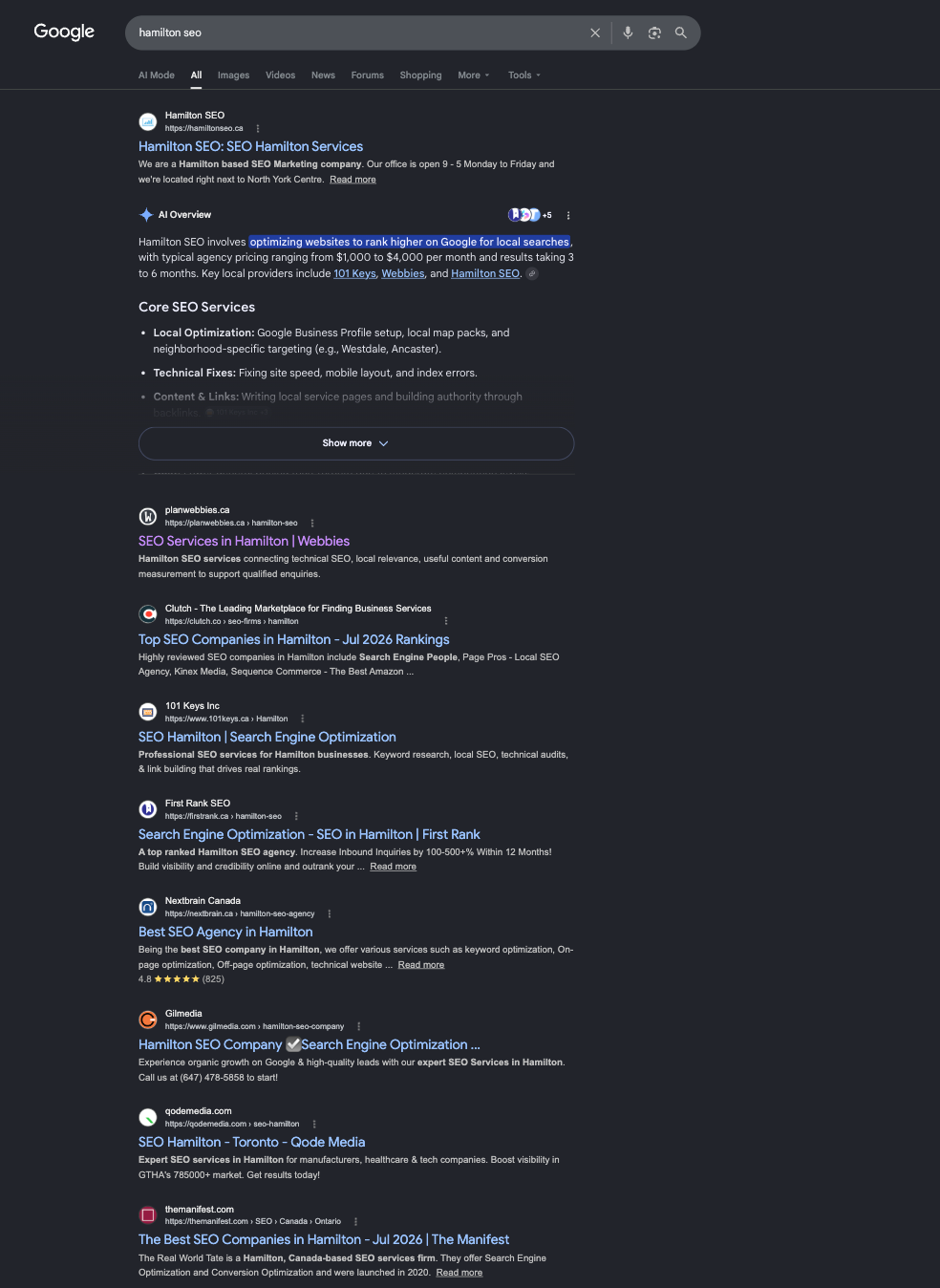
In our desktop observation dated August 3, 2026, Google named Webbies inside an AI Overview for “hamilton seo” and also displayed our Hamilton SEO page as an organic result.
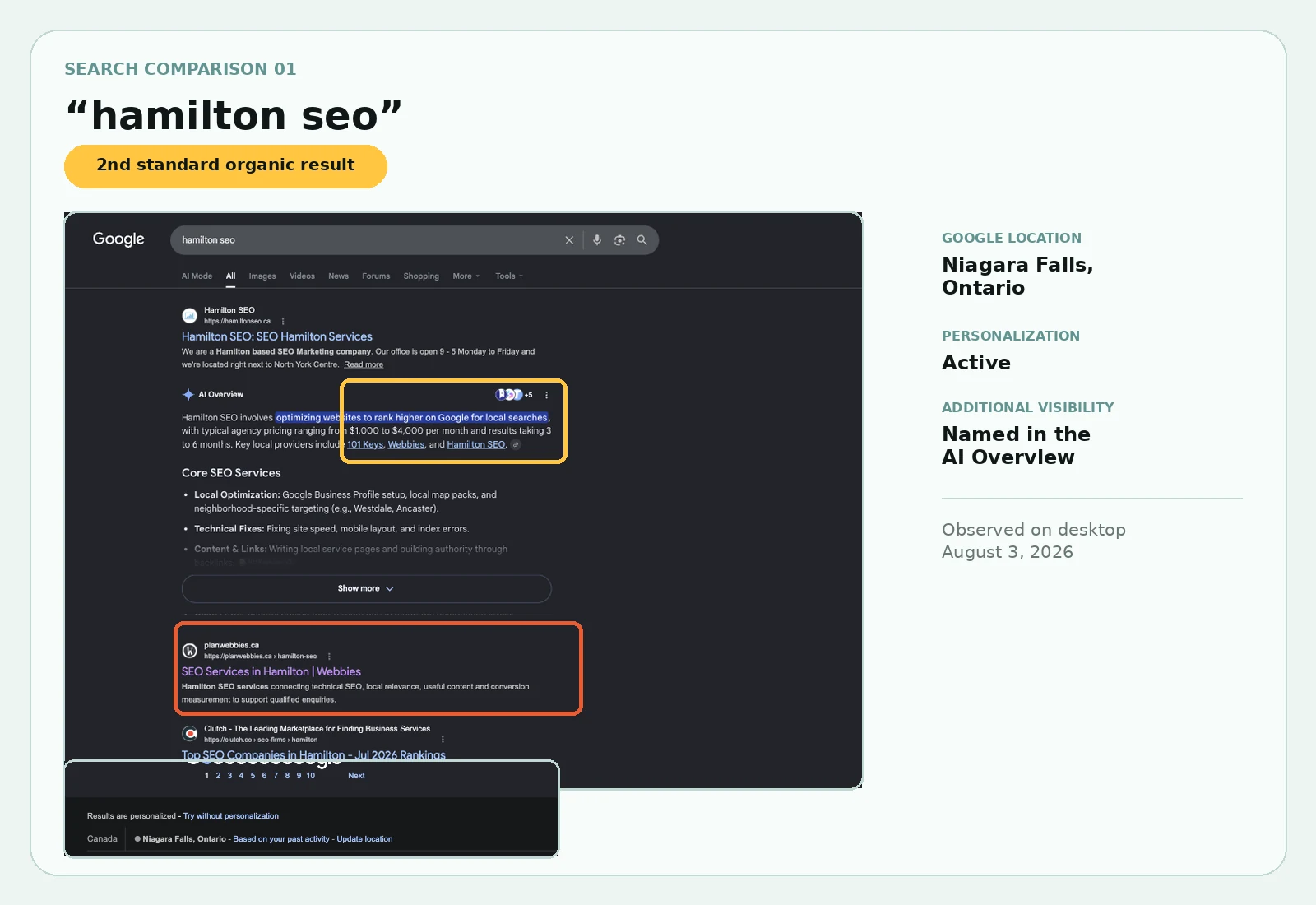

The useful lesson is that an organic position and an AI mention describe different things. Recording only one would leave out part of what appeared.
The screenshot does not show an expanded AI source destination, so we cannot count it as a confirmed citation to our Hamilton page. It also cannot tell us how many people visited, or which change caused the appearance. We keep those questions separate from the observation itself.
When checking your own visibility, save the exact query, date, platform and mode, displayed location, visible personalization setting and result. If a source link appears, open it and record the destination. Our explanation of why Google rankings differ shows the wider context behind this example.
Support your answers with real business evidence
Show why the information deserves consideration. Depending on the page, that could mean a project photograph, an explanation of a decision you made, a dated example, a clear author role or a result with its measurement period.
For a service business, check that your website and relevant public profiles agree on your name, contact details, location and actual services. Correct important errors before opening more profiles. When your services, coverage, opening hours or other important facts change, update each relevant page and profile where they appear. Changing a “last updated” date alone does not correct outdated information. A useful industry listing or genuine customer review has a different purpose from a paid placement or a repeated brand mention.
Choose supporting channels your customers actually use. There is no reason to manufacture forum comments or publish a fixed number of social posts simply to make your business name appear more often.
Measure AI visibility and website visits separately
Use a separate label for each observation. A business name in an answer, a linked page and a recorded visit should never become one interchangeable “AI ranking” number.
| Observation | What it establishes | What it does not establish |
|---|---|---|
| Organic listing | Your page appeared in conventional results for the recorded search context. | AI inclusion or a website visit. |
| Business mention | The answer named your business. | A linked source, endorsement or visit. |
| Confirmed page citation | The answer explicitly attributed information to an exact linked page. | That someone clicked or became a customer. |
| Google AI impression | Google recorded a display of a site link in a supported generative AI feature. | An isolated AI click, enquiry or sale. |
| Referral visit | Your analytics recorded a visit attributed to a referring source. | Every AI-assisted visit, or the exact answer that prompted it. |
Google’s Generative AI performance report reports impressions for AI Overviews and AI Mode. Its documented dimensions include pages, countries, dates and devices; it does not provide an AI query list or separate AI clicks and CTR. If the report is missing, Google says insufficient impressions can be a reason.
Keep using the ordinary Web performance report for clicks and query/page trends. Its data overlaps with the AI report, so adding the two impression totals would double-count some visibility. Review recorded referral visits in analytics separately, including which pages people reach.
Record the date and scope of each website change. Compare equivalent periods where data is available, and note other changes that could affect the result. A lower click-through rate with a similar average position is a reason to investigate; by itself, it does not show that AI caused the decline.
What should you fix first?
Choose the next task from the problem you can actually demonstrate.
| What you find | Next action | How to check the work |
|---|---|---|
| The intended page is inaccessible or excluded. | Resolve the relevant indexing, access or inclusion issue. | Recheck the URL and applicable platform controls. |
| The page gives a vague answer. | Add the missing scope, conditions, examples and next step. | Ask whether a customer can now make the decision the page is meant to support. |
| The page makes claims without evidence. | Add a genuine example, source or appropriately scoped result. | Confirm that the evidence supports the exact claim. |
| Your business is mentioned without an identifiable source link. | Record a mention and check the visible source panel. | Count a citation only when attribution to the destination is confirmed. |
| Visibility appears, but useful visits remain limited. | Investigate the query, result format, page proposition and analytics coverage. | Compare relevant page/query trends before deciding that another rewrite is needed. |
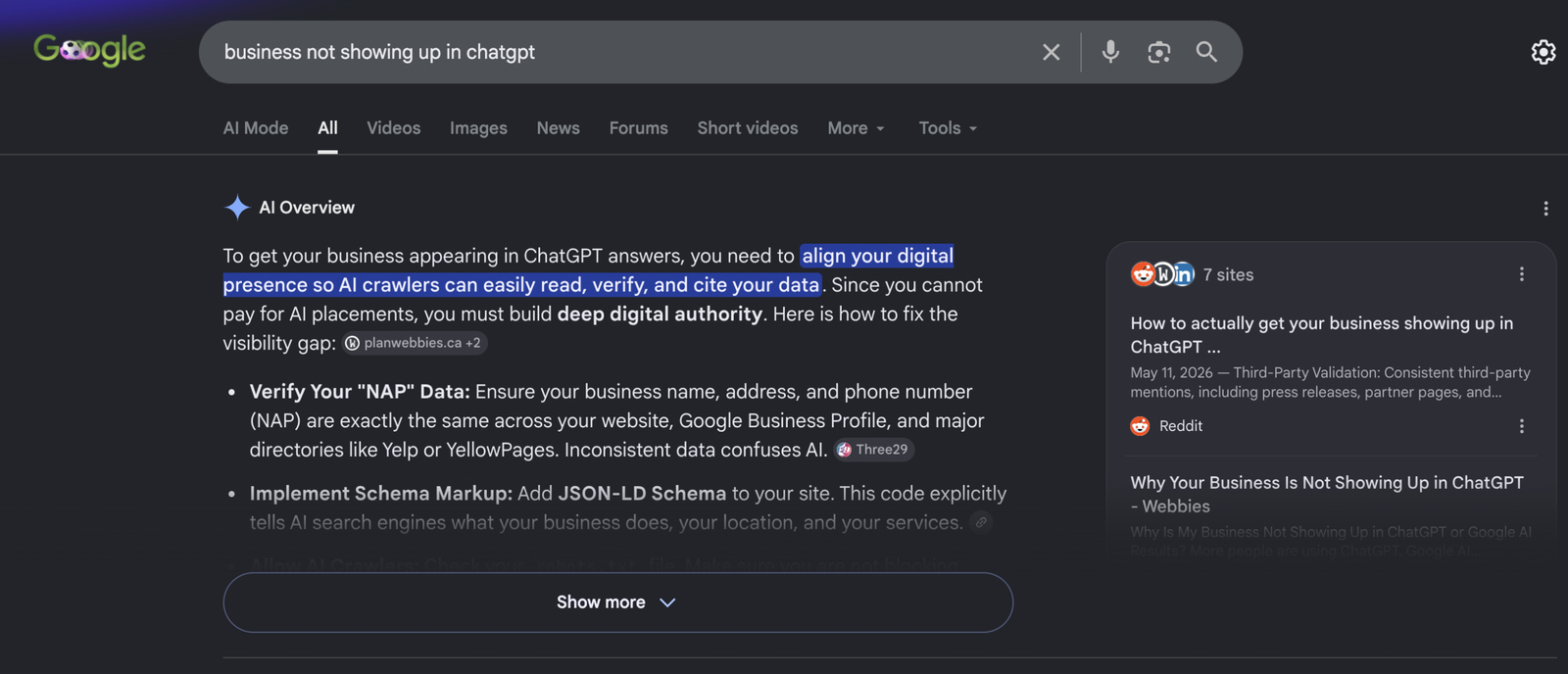
If your main problem is absence from ChatGPT, start with our guide to why your business is not showing up in ChatGPT.
For your first round of work, choose one customer question and page, record its current state, fix the clearest issue, and note what changed. Check access and answer quality first; evaluate visibility and visits as evidence becomes available.
Need help choosing what to improve first? Explore our SEO and Local Search services, including technical SEO, content strategy and internal linking, and discuss the priorities for your website.
Similar Articles